What Are You Even Selling? — On Naming, Desire, and Building an Independent Art Brand that Refuses to Fit In
- Hand Fetish Projects

- Jul 13, 2025
- 8 min read
Updated: Jul 26, 2025
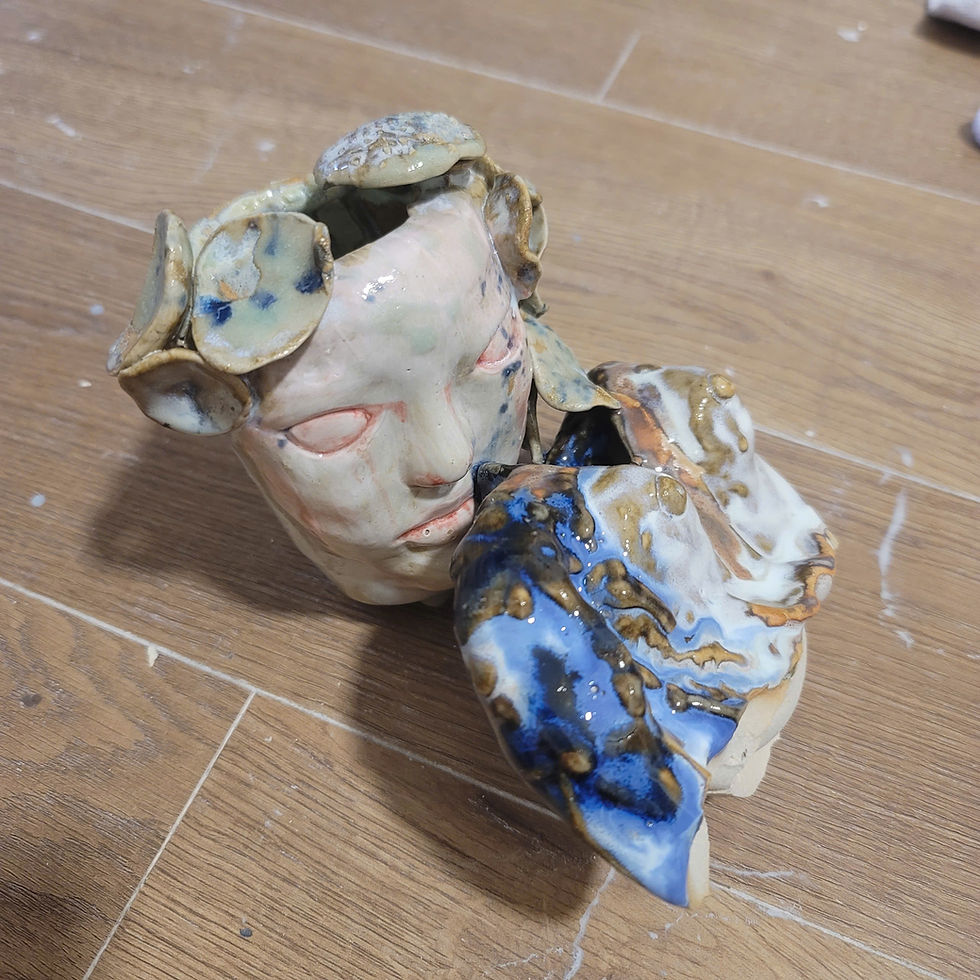
Hand Fetish Projects® (HFP) resists being boxed in. It doesn’t operate like a typical brand. Production is minimal, but its forms are boundless — spanning from humble, merch-priced objects to singular pieces that sit comfortably within the realm of fine art.
Each item is made by hand, but more importantly, made by vision. And while the images may fit seamlessly into Pinterest boards, the artist behind them does not. She moves quietly, wrestles inwardly, and only brings into view what feels honest to show.
At the core of HFP is Gối — an artist who left commercial design not to escape work, but to reclaim it. In this rare conversation, she speaks about the strange alchemy of naming, the discomfort of visibility, and why her most sensual works are never meant to explain themselves.

HFP: What made you start Hand Fetish Projects®?
Gối: I used to be an art director in advertising — a good one, in fact. But over time, it became clear that I didn’t like the job. Everything had to be done immediately, and even if you stayed up for nights creating something clearly thoughtful and beautiful, someone else could easily toss it in the trash just because they didn’t like it. And even if it was “good enough” to make it through the campaign, the client would forget about it within weeks. It all started to feel meaningless.
People often assume being an art director is glamorous — but in reality, it’s mechanical. In Vietnam, ADs are mostly tools for clients, and sometimes for incompetent creative directors. You don’t define the style; you just follow the brief. I remember a campaign where the client wanted an illustration from a famous internet artist for the packaging. One of our team’s illustrators had to sketch the full composition for approval — maybe because the client wanted to save costs. Another time, I was asked to write about the mission and artistic path of a well-known photographer, and I ended up inventing the entire concept — layering meanings that I wasn’t sure he even believed in. I didn’t know who would be credited if the idea was approved. I kept putting myself in the shoes of that internet artist, and that photographer: would they be okay letting someone else speak and create on their behalf? Because accepting that is already a form of identity crisis.
And for people like us — me and my colleagues, the ones doing the actual work to build someone else’s reputation — the entire process felt like a high-level insult. It was unethical.
This kind of sophisticated theft has long been normalized in advertising. No one questions whether it’s right — not even the people being “used.” But I couldn’t accept it. I kept doing the work out of necessity, all while hearing agency owners call it a “win-win” relationship. Looking back, I think that experience planted the seed of my countercultural mindset.
It gave me an identity crisis that lasted a long time. I felt like nothing more than a mood board made up of target audiences. I needed to do something for myself. To touch materials. To return to the artistic instinct I started with — the one that doesn’t ask for permission. Strategy could come later. First, I needed to feel like myself again.
So I quit. And HFP began — slowly, awkwardly, but honestly. What I do now is a quiet resistance to everything that goes against my values.
HFP: That name — "Hand Fetish Projects" — it’s bold, weird, and definitely not SEO-friendly. Where did it come from?
Gối: It took me two full months to come up with the name. One day, it just appeared in my mind — sudden, instinctive — and I grabbed it immediately. It felt seductive, almost like it exposed me, yet at the same time, it hinted at the handmade.
At first, I didn’t even register that the word “fetish” was flagged by algorithms as sensitive. It wasn’t until I asked for SEO advice on a forum that people warned me to drop it. They said it would confuse casual browsers and drive away traffic from my online shop. But honestly, I couldn’t find a better name to hint at the niche I’m in. I’m not just selling ceramics, so putting “ceramic” in the name felt limiting. I also didn’t want to box it into “craft.” I have a loud, layered manifesto behind every piece I make — and most people still don’t really understand what I’m trying to sell. That’s because they’re used to brands that serve everything up plainly.
But for me, naming the brand was a matter of survival. HFP doesn’t have a physical storefront. And yet, I couldn’t just spell it all out either — that would kill the mystique of an artist-led brand. I don’t have a Nguyen-Hue-Street showroom to exude urban sensuality (which is literally part of my manifesto). I don’t have a gallery space to imply collectibility. All I have is the name, the work, and a few lines of copy. If someone wants to encounter my work, it all starts with the name.
To me, “fetish” simply means obsession — a fixation on something. In the context of this brand, it means I’m obsessed with the physical act of shaping what I make, with my own hands. Not just directing ideas to a craftsman or outsourcing it to a factory. Only when concept and craftsmanship are seamless does the object gain soul. I crave the labor of making. I want to hold the brush, pour the resin, shape the clay — not just think about it.
Since AI went mainstream, I knew my time had come.
AI can think for us, but it struggles to create things that carry the trace of human thought. My view might be the opposite of most: while people fear AI will replace manual labor, I believe it’s the opposite. When I named the brand Hand-Fetish-Projects, I was daring the algorithm to try and understand what I’m doing. I trust that the new generation of AI is capable of understanding context — and guiding my work to those it truly resonates with.
Because let’s face it — if the name were something like “Ceramic Studio” or “Craft & Co.,” it could’ve easily been bot-generated. But “Fetish”? That’s a word only a human would dare to use. Too sexy, too offbeat, too metaphorical. It’s not neutral, not safe. And that’s exactly what I needed — a name that makes people pause. A name that no bot could ever wordplay into existence. A name that’s wrong enough to be right.
Sometimes, you don’t need a long statement. The name says it all.
HFP: What defines the aesthetic of this independent art brand — subtle seduction or quiet rebellion?
Gối: I see HFP as a quiet rebellion. I’m not here to shock, but I’m also not here to be polite. I place people — and the urban soul — at the center of everything I create. Because I live and breathe in one of the noisiest cities in the world, and I want to express my views without making a scene.
HFP exists to help young urban dwellers — burdened with thoughts and pressure — reclaim space through art. I try to blur the line between function and ornament. Apartment life doesn’t allow room for both, so why not merge them into one? It’s as simple as that.
And again, as I’ve said before: you don’t need a manifesto when the brand already speaks for itself — through its name, and its objects. We’ve talked about the name. So let’s talk about the work.
I’ve always been drawn to visual tension — the kind that makes people pause and look again. Like the innocence inside an erotic gesture, or the strange precision behind something that appears chaotic. I often wonder how far a piece can be pushed before it breaks — and how that near-breaking point generates energy.
I want all of that — gentle eroticism, chaos disguised as balance (and sometimes the reverse), poetic discomfort — to live within these hybrid objects. HFP doesn’t cling to any one material or function. What matters is the sensation the piece evokes.

HFP: You call this a “project,” not a brand or studio. Why is that distinction important?
Gối: Honestly, I didn’t set out to start a company. It all began because I was fed up with the identity theft tactics so common in agency work — and I needed to create something of my own to anchor myself. But the more I worked, the more joy I found in it. I started to see real potential. In Vietnam, the niche brand model is still rare. I hope to bring a piece of Vietnam to the world — and bring the world back to Vietnam in return.
Today, HFP is officially trademarked in the U.S., and I’m genuinely proud of that. I’ve come much farther than I ever expected. Maybe it’s not a big deal compared to the hundreds of thousands of brands out there, but to me, it marks a milestone. At this point, there’s no turning back — I’ve made a commitment to move forward.
I still do most of the work myself. Not because I’m a control freak, but because I know no one understands HFP better than I do. Of course, the act of creating is important. But the entire system behind that creativity — the work that allows it to thrive — is a mountain that only someone in this position can truly grasp. Right now, HFP has one art director (me), one CEO, and one developer. We’re comfortable with this lean structure.
I designed the website, wrote the content, took the photos, and of course, designed the logo — which shows two hands folded into each other, forming a yin-yang shape. And yes, it’s suggestive — in the best possible way. Sometimes I think… maybe I really do have a hand fetish.
HFP: Where is HFP going? What’s next?
Gối: HFP will always hold its ground: to create products that are not made for the masses. That’s why it will stay small.
It’s not about censorship. It’s about taste. To this day, most of my friends still don’t understand what I’m selling — which is kind of funny, because I actually think I’m pretty good at explaining the concept. Maybe too good. It seems people prefer to immediately label an object — a printed water bottle, a ceramic lamp, a serving tray — but they struggle with objects that hold multiple meanings. And if you have to explain something over and over, maybe the problem isn’t the explanation. Maybe it’s simply that the thing isn’t for them. And that’s perfectly fine.
That’s why I had to reach beyond borders. My niche is too narrow to survive in just one country. I’ve seen so many amazing niche brands abroad — brands I had no prior concept for — often artist-led or co-created. They inspired me deeply. I want HFP to become that kind of underground brand in Vietnam — a space that gives voice to counterculture and the unorthodox.
I always put into my designs the things I can’t (and don’t want to) explain with words. And I want HFP to grow through connecting with others who feel the same. Whether it’s through marketing or product development, I’d love to collaborate — as long as the spirit remains intact.
That said, from day one until now, I’ve done everything alone. And honestly, I don’t mind if it stays that way.
Don’t buy things just because others do. Buy what speaks your truth.

Comments